Country earned start of accession talks a long time ago, EU has to give clear vision for Macedonia, Nikoloski tells MIA
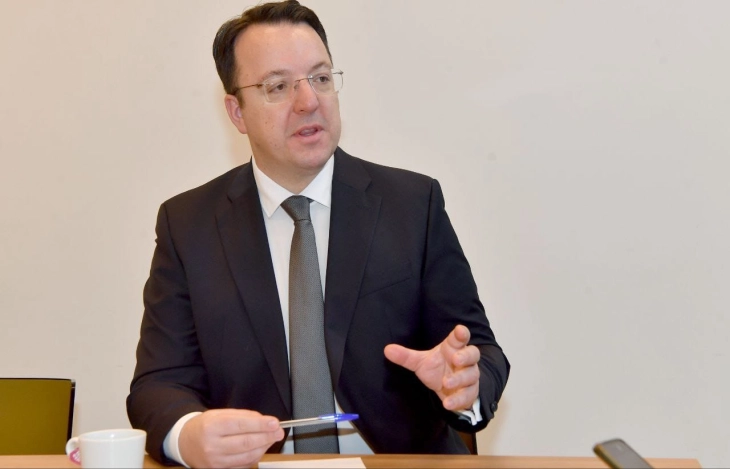
Brussels, 5 December 2025 (MIA) - Macedonia has earned to start the EU accession talks a long time ago and therefore the Union should put pressure on those who block the enlargement process so it continues, says Deputy PM and Transport Minister Aleksandar Nikoloski in an interview with MIA's correspondent from Brussels.
Deputy PM Nikoloski, who is taking part at the EU - Western Balkans Summit organized by the Friends of Europe think tank in Brussels, says certain European diplomats have recognized that the enlargement process is, first and foremost, a political matter, and then come reforms, criteria and merit.
On the constitutional changes, Nikoloski says the key issue is whether their adoption is the final requirement or a veto would come again after a few years.
Below is the interview with Deputy PM Nikoloski in full:
You took part at the EU - Western Balkans Summit organized by the Friends of Europe think tank. The EU insists that a requirement for membership is meeting the criteria, but there were cases of turning a blind eye with some new member-states. Can we expect the EU to give precedence to stability ahead of the strict requirements of the accession process amid the current geopolitical circumstances?
You are right. I think that the EU debate is starting to change, and this is good, especially after the military aggression in Ukraine, this is something rather worrying for the region and Europe. No one expected a war could happen in the 21st century.
However, the EU is becoming more resilient and certain European diplomats recognized during the summit that the process is, first and foremost, a political matter, and then come reforms, criteria and merit. This is a big change in the narrative if you compare it with debates a few years ago, when everyone said the process is exclusively merit-based.
If we already know that the process is political, then political decisions are required, meaning that EU's leading members have to give a clear vision for the region, including Macedonia. To put pressure on those who are blocking the enlargement process so it continues and the country starts the accession talks. Because Macedonia has earned this a long time ago.
You mentioned that we deserve the start of the accession negotiations but there is a permanent insistence on us meeting the requirement of constitutional changes. Is there anything new on that front?
The key issue is whether this is yet another requirement, the final requirement, or not. We have said that the constitutional change under Bulgarian dictate will not happen. There have been ideas circulating towards overcoming this situation. While in opposition, we discussed the constitutional changes with delayed effect, entering into force once Macedonia completes the accession negotiations.
We are also discussing Bulgaria's tasks so that the process is balanced. There are 14 judgments of the European Court of Human Rights related to Macedonians in Bulgaria that must be applied by member-states. Bulgaria has not implemented a single one.
Therefore, the process must be a two-way street and it must guarantee that we will not sit here in a few years from now and again talk of obstacles, of someone again putting roadblocks due to internal political reasons or related to elections or whatever. The process must be predictable and we must know when the negotiations start and finish, of course if we realize reforms required by the EU.
You will also take part at the Ministerial Council of the Transport Community in Brussels, focusing on the transport policy and infrastructure projects in the Western Balkans, including Corridors VIII and X. In this context, what is the latest on the fast rail project?
We are making excellent progress. Preparations are ongoing and a prestigious international company has been hired, one recommended by the United Kingdom as well.
In parallel, we already have the best indicative offer for the project's financing, and we will soon go into the process of selecting a contractor.
Therefore, preparatory activities have started, and I expect the machinery to take the field sometime during the summer.
You signed the agreement on the Corridor VIII cross-border railway tunnel with Bulgaria. When can we expect works to start and when will we travel from Skopje to Sofia by train?
Hopefully in 2031, provided Bulgaria is working with the pace that my Bulgarian colleague has promised. We have completed the first section from Kumanovo to Beljakovce, whereas the second one (Beljakovce-Kriva Palanka) is currently being built. Preparations for the release of a tender for the third section (Kriva Palanka-Deve Bair border crossing) are ongoing and we expect several companies to apply. We expect the tender to be announced in January at the latest.
How satisfied are you with the dynamics of works on the Kichevo-Ohrid motorway and the Bechtel-Enka highways? Can we expect some sections to be put into use soon?
Yes, I expect a new portion of the Kichevo-Ohrid motorway to open around New Year's. Things are moving forward in this project that was rather forgotten, but we are now seeing light at the end of the tunnel.
We are also working together with the European Bank for Reconstruction and Development on selecting contractors for the Kichevo-Bukojchani motorway section. Works on the section from Gostivar to Bukojchani are also ongoing, with 17 out of 32 kilometers already broken through. In addition, we are actively working on the Gostivar-Tetovo and the Prilep Bitola highways.
Will these infrastructure projects have an impact on the construction sector?
A lot, and I expect double-digit growth in the field. Next year's growth is expected to surpass ten percent, thus entirely changing Macedonia's economic outlook.

Let's turn to airlines. Can we soon expect some news there, any new routes from the Macedonian airports?
We opened 21 destinations in about a year, which for a small country like Macedonia with only two airports is a lot. I expect the Kraków and Wroclaw destinations from Ohrid to be launched in May, along with the Vienna flight from Ohrid as well.
In addition, the Skopje-Dubai flight will be operational as of February.
What's the progress with the implementation of the One-Stop-Shop system and cross-border cooperation to facilitate the transport of people and commodities?
We are nearing completion of a project titled New Single Window, implemented in cooperation with the World Bank. To put it simply, implementation will mean that cargo transporters will not have to stop at borders if they meet requirements, and fill out all documents online. These documents will, of course, be checked by competent institutions.
The same is being introduced by Albania, Serbia, Kosovo, Bosnia and Herzegovina and Montenegro. This means that if a commodity is loaded at Albania's Durrës post, it can travel all the way to Serbia's Novi Sad without stopping at borders.
We started with the EU, so let's finish in the same way. How far along is the country with implementation of the tasks within the Growth Plan and the National Transport Strategy?
We are satisfied with the pace. Everything that needs to be realized within the Growth Plan is on track, and regarding the National Transport Strategy, I expect to see the numbers for the third quarter by the week's end. Growth in transport and logistics stood at 6.1 percent in the first half of this year, compared to the same period in 2024. Growth in construction is even higher at nine percent. Therefore, these three sectors are the generators of the Macedonian economy.
Photo: MIA