Transport Community report: Focus on traffic safety, railway modernization, road maintenance
Skopje, 21 April 2026 (MIA) - In its report, presented Tuesday in Parliament, the Transport Community noted the country’s progress in the construction of road infrastructure, while stressing the need to plan for its maintenance as well. According to the Community it is essential to work on building and modernizing the railway system, with particular emphasis on overcoming the problem of rail connectivity with Bulgaria following the signing of the agreement for the construction of the cross-border tunnel, as well as the launch of the first of three sections that make up the Skopje-Sofia railway line.
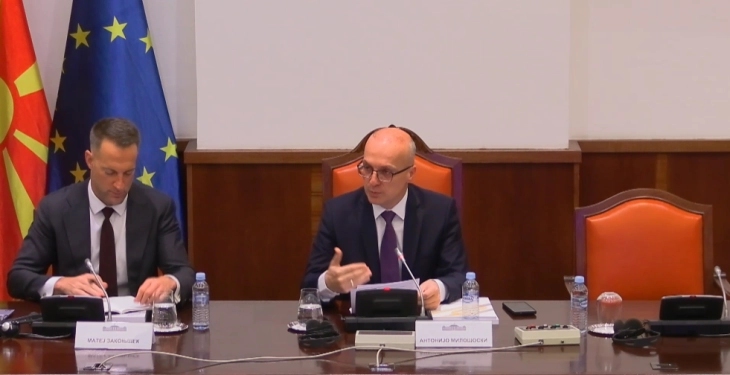
“In order to achieve full integration of Western Balkan transport markets within the European Union, reforms and projects should move hand in hand,” said the head of the Transport Community, Matej Zakonjšek, during the presentation of key findings from the Transport Community’s 2025 Annual Reports at a session of Parliament’s Committee on European Affairs.
Progress in the railway sector stands at 62 percent, which, Zakonjšek said, means that 62 percent of the action plans for the 2025–2027 period have already been achieved. For roads, progress is at 52 percent; 44 percent for road safety; 29 percent for transport facilitation; and 36 percent for passenger safety and rights. “These percentages need to reach close to 100, or be at 100 percent, by 2027,” Zakonjšek noted.
On road infrastructure, progress has been noted in the implementation of the 10-year strategy for the development and maintenance of state roads.
“We see that new projects are being delivered, but funding for maintenance is not planned in time, and there needs to be a multi-year maintenance plan. Recommendations for the road sector also focus on the revised law for the introduction of intelligent transport systems. The new ‘Safe City’ system launched this year is a key element when we talk about road safety because we know how many accidents happen especially in the cities. In North Macedonia, the average is 77 fatalities per million inhabitants, and across the region the rate is quite higher than the EU average. That’s why the focus is on safety and the aim is not to reduce this to 45 or 30 or 20 fatalities but to zero. This is possible through the implementation of the safe system approach which means the whole of society working together. There should be a coordinating body or a road safety agency. Recommendations also include improving road safety data and collecting it the same way as in the European Union, adopting a road safety law, and operationalizing the road safety agency,” Zakonjšek said.
Zakonjšek noted North Macedonia is a connected country through the corridors that pass through the country, which are being modernized to function as they should. In the railway sector, he said, there are 58 kilometers of renewed projects and 365 kilometers of projects in preparation, with some sections already underway.
“The value of these projects stands at EUR 1.15 billion, with the focus placed on modernizing the railway network, which has long been neglected. We should focus on this if we want modern rail transport and a multimodal network. Since last year, a new section of Corridor VIII has been put into operation, and an agreement was signed between North Macedonia and Bulgaria for the construction of the [cross-border] tunnel, which is an important achievement. The state of most of the railway network is marked in red, meaning it requires improvement. Road projects are progressing well, significant funds have been spent over the past period, and additional projects lie ahead - 190 kilometers are currently under construction or reconstruction. The alignment of the road network compared to the railway is considerably better, though there are sections that still need to be completed or built,” the head of the Transport Community said.
The Chair of the Committee on European Affairs, Antonijo Miloshoski, in his address at the session noted that transport policy is part of Cluster 14 of negotiations and represents a significant part of the EU accession process, with the Transport Community being a significant and stable partner. He touched upon the progress made on Corridor VIII, noting that it is under construction after previous challenges were overcome.
Photo: Screenshot