Macedonian-Croatian mixed committee for minority rights protection convenes in Skopje
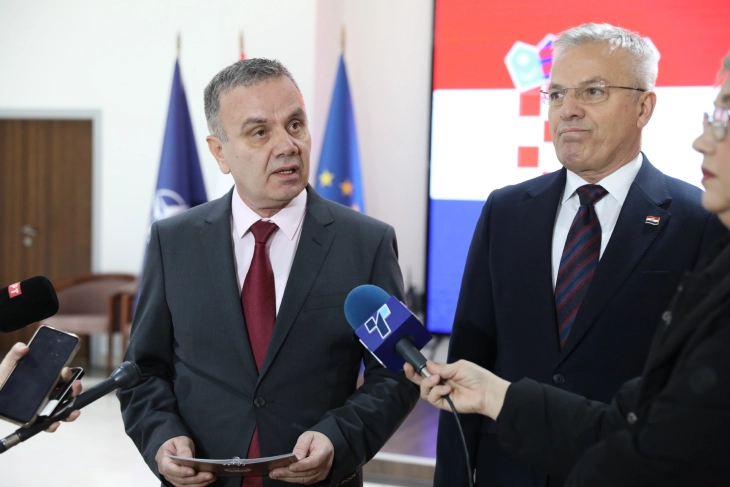
Skopje, 5 February 2026 (MIA) — The Intergovernmental Mixed Committee for the Protection of Minorities in North Macedonia and Croatia has convened Thursday in Skopje, with participants voicing expectations of an open and constructive discussion ahead of its seventh meeting.
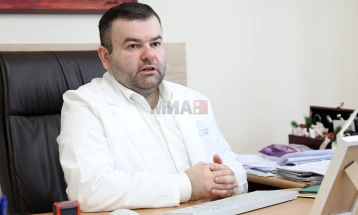
"Every one of these meetings is an opportunity to strengthen relations between the two countries; an opportunity to show dialogue works; and an opportunity to add momentum to our common European future," Deputy Minister of Foreign Affairs and Foreign Trade Zoran Dimitrovski told reporters before the meeting.
"We are two friendly countries with a long tradition of cooperation. Today's meeting is another confirmation of that cooperation. Cooperation that is built on mutual respect, common values and a sincere desire for progress," he added.
According to Dimitrovski, North Macedonia was built on the principles of coexistence, tolerance and respect for diversity.
"Caring for national minorities both at home and abroad is our strategic commitment. This is particularly important in the context of our European agenda. Our process of accession to the European Union is not just an economic or political project. It is a question of values, and respect for minority rights is one of the key indicators of the rule of law, democratic capacity and institutional readiness of the state," he said.
"It shows how European standards are applied in practice, not through declarations but through concrete dialogue, partnership and a reciprocal approach. This is a model that can serve as an example for other bilateral relations in the region," he said.
The deputy FM thanked the Republic of Croatia for its treatment of the Macedonian minority living there.
"Croatia provides support in education for our minority, from learning our mother tongue to access to educational resources," he said.
"There is institutional openness to the needs of our community. The Macedonian minority has media representation and opportunities for cultural affirmation. These policies are in full compliance with European standards and deserve high recognition," Dimitrovski said.
He also said Croatia was a role model of honoring human and minority rights. "For us, it is an important source of experience and good practices to learn from," he said, adding that "partnership is a two-way street, however — and we are firmly committed to reciprocity."
He said the Macedonian government, too, was firmly committed to continuously improving the position of the Croatian minority in the country through improving institutional support, strengthening educational opportunities, supporting cultural activities and preserving the Croatian identity by better media representation and visibility.
Croatian State Secretary of the Central State Office for Croats Abroad Zvonko Milas, who together with Dimitrovski is co-chairing the meeting, said holding regular committee meetings over the past years demonstrated both governments' committment to improving the protection of minorities, both the Macedonian community in Croatia and the Croatian community in North Macedonia.
"I am sure the recommendations we made at the last meeting in Zagreb and sent to our governments — and those we will agree on at the seventh meeting today — will contribute to an even better and higher quality of life and nurturing of values that our people, our compatriots, need to be able to live and feel as if they belong to the nations they belong to, regardless of the countries they live in," Milas said.
"I would like to point out with pride that the Republic of Croatia truly holds the Macedonian minority highly protected in the context of minority rights. This is guaranteed to them by our Constitution and I believe one day we will also see that this is also the case for the Croats in Macedonia, in line with the statements of the highest Macedonian officials and the positive progress in the past few years," he said, adding that both governments would work together to ensure that Croats receive the status of a national minority in the Constitution.
He thanked the Macedonian authorities for supporting Croats here in safeguarding and developing Croatian cultural heritage and identity as well as learning the Croatian language.
"The Central State Office for Croats Abroad will continue to be, like other institutions of the Republic of Croatia, in support of the Croats in Macedonia," Milas said.
"We will be focused on working with children and young people, because all we want is for them to connect with their native homeland. We want them to develop a sense of belonging to the Croatian people through learning the language, to feel the need to come to Croatia and see what the homeland of their mothers and fathers, or of their grandparents, is like," he said.
Milas also said he was looking forward to the "friendly cooperation from our friends from Macedonia, the government and all who can contribute to the members of the Macedonian minority in Croatia, or the Croatian minority in North Macedonia, to live their lives as loyal citizens of the countries they live in while at the same time having all that is important to them to cultivate their own sense of belonging to the people they belong to."
The Intergovernmental Mixed Committee for the Protection of Minorities in North Macedonia and Croatia was established on the basis of the agreement signed in Split in 2007 and it has been a stable and constructive mechanism for partnership-based, result-oriented dialogue between the two friendly countries. mr/
Фото МИА