Europe tops global smoking rates, Balkan countries lead with double the figures of Western Europe

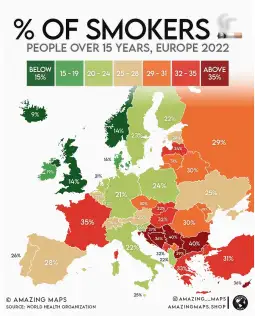
Skopje, 28 January 2026 (MIA) - Europe has the highest smoking rate in the world, with an average of 25.9 percent of people over the age of 15 using tobacco products, shows data published by the platform Brilliant Maps, based on the World Health Organization’s global report on tobacco and nicotine use trends from 2000 to 2022, with projections extending to 2030.
The Balkan countries are among the European countries with the highest smoking rates. The most active smokers have been registered in Bulgaria and Serbia, where 39.5 percent of the adult population uses tobacco products, followed by Croatia with 37 percent, Greece with 32.8 percent, Slovakia with 32.4 percent, Hungary with 32.2 percent, and Romania with 30 percent, which is significantly higher than the European average.
Smoking rates in Western Europe are lower, but significant differences exist between countries. France has the highest smoking rate in Western Europe with 34.6 percent, which is above the European average and closer to the level of the Balkan countries.
There is a concerning trend among young people, especially when it comes to e‑cigarettes and new nicotine products. More than 100 million people worldwide use e‑cigarettes, and in some European countries, the rates among adolescents aged 13 to 15 are even higher than those among adults.
The WHO report shows that, despite a global drop in tobacco users from 1.38 billion in 2000 to nearly 1.2 billion in 2024, tobacco use remains a serious threat to public health. Europe is the only region not expected to meet the 30 percent reduction target set in the WHO’s global action plan, and projections indicate that by 2030 it will still have the highest tobacco prevalence, at over 23 percent.
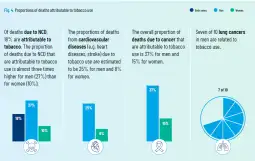
Data shows that 18 percent of deaths from non-infectious diseases in Europe in 2019 were related to tobacco use, which means that every fifth premature death could be avoided if tobacco is eliminated.
In the Republic of North Macedonia, data from the Public Health Institute (PHI) published on World No Tobacco Day in 2024 shows that 45.4 percent of the country’s population are active smokers, which is significantly higher than the average in the European Union and ranks North Macedonia among the countries with the highest smoking rates in the world.
According to the PHI, the number of people who show up at smoking cessation counseling centers, which function within public health centers nationwide, is very low, with only 43 people seeking help in 2023.
The Institute stressed that tobacco use seriously contributes to the worsening of the general health of the population, stressing that regular use of tobacco could lead to cardiovascular, respiratory, reproductive, malignant, endocrine and many other types of diseases.
The tobacco industry, according to the Institute, is successfully using its resources to fight efforts to strengthen legislation which is in fact one of the conditions for accession to the European Union. The need to harmonize the legislation with that of the EU is essential for the country’s progress, it said.
“Although the Republic of North Macedonia ratified the WHO Framework Convention on Tobacco Control back in 2006 and over the years there have been efforts to strengthen health regulations related to tobacco use, in recent years progress has stalled. The bans on smoking on the terraces of hospitality venues have been lifted, and the use of electronic devices that heat rather than burn tobacco has been allowed in enclosed public spaces,” the Institute underscored.
The WHO and other international health institutions are calling for stronger national and regional control on tobacco by raising taxes, strictly enforcing bans on smoking in public places, limiting advertising, and expanding programs that support quitting.
Photo: MIA file photo/Screenshot


