Prévot: EU must schedule meeting to review its decision-making process for enlargement success
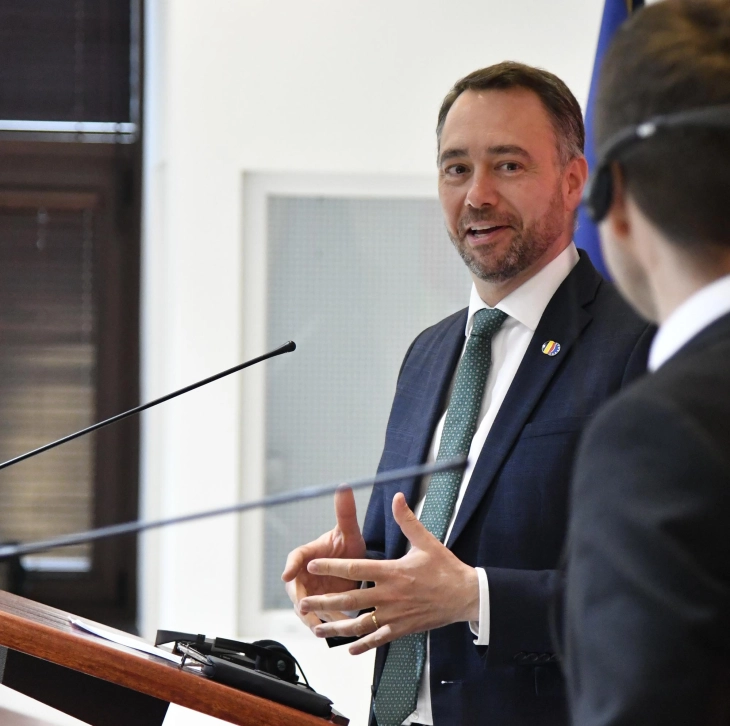
Skopje, 15 April 2026 (MIA) - One of the main conditions for the success of the accession and enlargement process is for the European Union itself to schedule a meeting to review its decision-making process, Belgian Deputy PM and Minister of Foreign Affairs, European Affairs and Development Cooperation, Maxime Prévot said answering journalists’ questions at a joint press conference with his host, Timcho Mucunski.
Asked whether Belgium would give up its veto right and accept the principle of qualified majority voting, Prévot said that “the recurring issue of unanimity in foreign and security policy has been painfully experienced in recent years and it has often led the EU into a situation of silence and inability to speak out as it should as a geopolitical power.”
“We have seen what happened with the Palestinian issue. We can be satisfied with the support we provided to Ukraine, but we are not happy that we are not at the table, even though we are paying for the meal. I believe that the functioning of these 27 countries, and in the future if we become more, should rely on qualified majority voting, which would take away part of the unanimity rule for certain very specific issues,” Prévot said.
According to Prévot, the future of Europe is being shaped as it transforms from not only a large market of millions of consumers, but into a genuine supranational geopolitical power in an increasingly multilateral world.
“Otherwise, we will face various mechanisms of blockage and obstruction. Just look at the veto mechanism in the implementation of security policies in the United Nations, which has very often led the UN into a form of polyphony in expressing its positions on international conflicts. Therefore, I believe this should be avoided,” Prévot said.
Answering journalists’ questions on how Belgium can help and prevent a future Bulgarian veto, Prévot said that North Macedonia has undergone several transformations over recent decades, which were both symbolically and politically significant. He said he believes that such a guarantee can be given in the sense that “there will be no new demands after six months” and that “there will be no renewed deadlock or blockage in the accession process.”
“I can, of course, speak on behalf of Belgium, not on behalf of all 27 member states. For us, there is a clear intention that these assurances should be given to North Macedonia once it completes that review, and that the path will be unblocked and open, through the standard stages of fulfilling the various chapters that need to be adopted, and that there will be no renewed obstacles or blockages along the way. I believe that all member states together can provide an adequate response, and that within the EU’s internal discussions the will can be expressed for these assurances to be offered to North Macedonia,” Prévot stated.
Prévot stressed that the European Union, as a global institution, can hardly give guarantees on behalf of each of its member states separately.
“What the European Union can encourage through dialogue, mediation, and facilitation is to take part in ensuring that North Macedonia will be able to implement the agreed constitutional changes and that no other member states will come forward after six months, one year, or 18 months with new bilateral issues in order to obstruct, halt, or block that path,” Prévot said.
Photo: MIA


