MIA at Areopagus, where St. Paul first preached Christianity to the Athenians
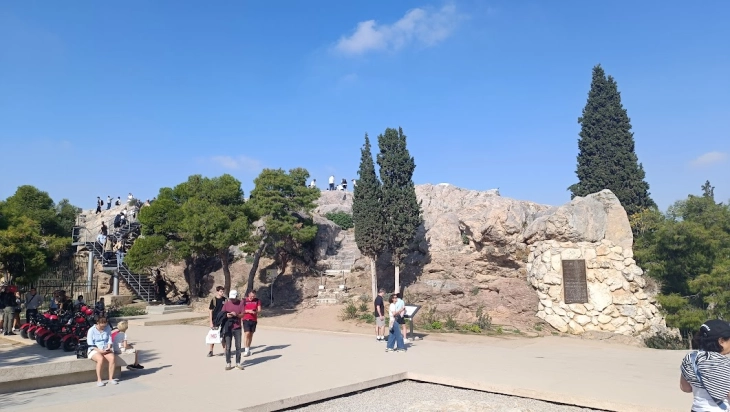
Athens, 7 November 2025 (MIA) — In the heart of Athens, Greece, between the Acropolis and the Pnyx Hill, the rocky hill of Areopagus rises to a height of some 115 m. Although small and modest, it is replete with history and symbolism – a place where ancient wisdom and Christian faith come together, the place where, according to records, Paul the Apostle first preached Christianity to the Athenians during his second missionary journey almost two millennia ago.

Situated northwest of the Acropolis and easy to access, the outcrop was the gathering place for the ancient Athenian judicial council handling cases of serious crimes such as homicide and arson as well as religious offenses. Legend has it that it was named (in Ancient Greek: Ἄρειος Πάγος – Areios Pagos) either after the god of war Ares — who according to mythology was tried there by the Olympian gods for the murder of Poseidon's son Halirrhothius — or after the Furies (Erinyes), the chthonic goddesses of vengeance and retribution. These days, though, it is swarmed with tourists and young Greeks all day long.
Areopagus Hill offers an impressive view of Athens, the Acropolis and the neighboring Mount Lycabettus. At the same time, it also offers some space for reflection and inspiration, amid an ancient setting and in a quiet, profoundly religious atmosphere.

It is here that, in 50 or 51 A.D., Paul the Apostle arrived — in a city that had just restored its splendor after the devastating fire set by the Romans — ready to deliver the words that would leave a lasting mark on Athenian spiritual life.
His visit to the Jewish synagogue and his conversations with converts to Judaism as well as with the Epicurean and Stoic philosophers are described in the Acts of the Apostles.

Intrigued by his teachings, the philosophers took him to the Areopagus, which was one of the most important Athenian institutions and sites for public discussion in those days. There, under the Acropolis, the apostle delivered his famous speech addressing the “unknown God” and the resurrection of the dead, one of the most significant sermons in the history of Christianity.

Today, on Areopagus Hill, where Athenian sages and philosophers once gathered, there is a bronze plaque engraved with excerpts of Apostle Paul’s Areopagus sermon recounted in Acts of the Apostles 17:22–31 in ancient Greek.
"And Paul stood in the midst of the Areopagus, and said, 'Ye men of Athens, in all things, I perceive that ye are very religious. For as I passed along, and observed the objects of your worship, I found also an altar with this inscription, TO AN UNKNOWN GOD. What therefore ye worship in ignorance, this I set forth unto you. The God that made the world and all things therein, he, being Lord of heaven and earth…," reads the engraved plaque quoting Apostle Paul's speech to the Athenian philosophers.

According to the plaque, the apostle then preached that "The times of ignorance therefore God overlooked; but now he commandeth men that they should all everywhere repent: inasmuch as he hath appointed a day in which he will judge the world in righteousness by the man whom he hath ordained; whereof he hath given assurance unto all men, in that he hath raised him from the dead."

There are different interpretations of why Apostle Paul was brought to the Areopagus. According to the Church Fathers — the early Christian theologians and writers — the reason was an ordinary trial, since such was the purpose of the Areopagus; and the case was dismissed as frivolous because he mentioned resurrecting the dead.
Others claim there was no trial, but that the apostle was brought there to be heard by an audience hungry for philosophical debate. They claim women, too, heard his speech, which would have been impossible had a formal trial been held. A third explanation, incorporating the previous two, is that Paul appeared before the Areopagus not to be tried, but to be heard so the judges could decide if his preaching posed a spiritual danger to the Athenians.

Apostle Paul's preaching, according to lore, converted to Christianity the prominent Athenian judge Dionysius the Areopagite — who later became the first bishop of Athens and, after his death, the patron saint of Athens — and a woman named Damaris.

Tourists admire the view of Athens and the Acropolis as well as the hill's historical significance
Areopagus Hill, just a few minutes' walk from the Acropolis, does not charge an entrance fee and is one of the historical sites every tourist should visit during their stay in the Greek capital.

Just like the Acropolis, the hill is easily reached by subway, a 15 minutes' walk from Acropoli station.
Stairs lead to the top of the hill, but hiking through the rocky terrain requires caution, minding the uneven surface and slippery slopes.

Areopagus attracts scores of tourists mainly because of its view of the Greek metropolis, together with the Acropolis and Mount Lycabettus on the opposite side, but after reading the information panels, they immediately perceive it differently.
Italians, Spaniards, Israelis, Americans and even a group of pilgrims from Romania admire the beautiful panoramic view of almost all of Athens, while also commenting that its symbolism and importance are much more impressive.

"This place is incredible. This is the starting point for Christianity in Greece, a symbol for the spread of Christianity. There are really no words," says an elderly Spanish woman, who is visiting Athens with her family.

A married couple from the United States is surprised to read on the information panel that this is not just a rocky outcrop offering a beautiful view of Athens.
"We didn't know, we really didn't know. We were focused on the Acropolis and Plaka and we didn't even check what else was nearby. But this... is so impressive, I'm speechless," they tell MIA's Athens correspondent.

Every year on June 29, during the Feast of Saints Peter and Paul, a special liturgy is held on Areopagus Hill, which comes alive in the spirit of faith and tradition.
Besides being the name of the hill where judicial councils met in ancient Greece and where Apostle Paul preached Christianity, the Areopagus (Areios Pagos) today is the name of the Supreme Court of Greece, one of the three highest judicial bodies in the Greek judiciary.
Sanja Ristovska


