Dzhikovski for MIA: No safe level of smoking; 700 new lung cancer cases annually, most at advanced stages
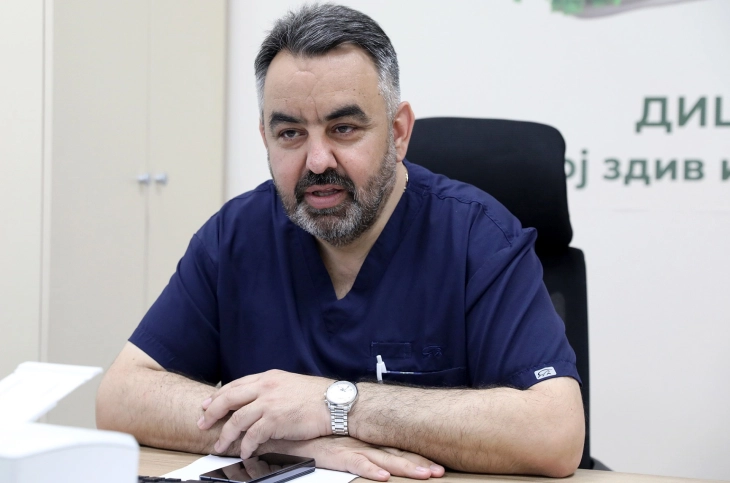
Skopje, 14 April 2026 (MIA) — Smoking cigarettes causes chronic damage to the lungs and blood vessels, leading to cancer, chronic obstructive pulmonary disease, sudden lung collapse, stiffened artery walls and aneurysms. It also causes narrowing of the large neck arteries, which often requires surgical intervention. Patient numbers continue to rise at the Clinic for Thoracic and Vascular Surgery. More than 3,100 people were treated last year; approximately 150 were smokers who underwent thoracic surgery for lung cancer. Each year, 600 to 700 new patients are diagnosed with lung cancer, the majority of whom are smokers. Most cases are diagnosed at an advanced stage and referred to the Clinic for Radiotherapy and Oncology for further treatment, according to thoracic surgeon Igorche Dzhikovski, director of the Clinic for Thoracic and Vascular Surgery, in an interview with MIA.
To reduce their risk of developing these diseases, Dzhikovski advised smokers to quit smoking entirely.
"Introducing a national lung cancer screening program would be of utmost importance for us," Dzhikovski said. "Early detection would significantly increase the number of patients diagnosed at an operable stage, directly improving surgical outcomes, reducing mortality and improving quality of life."
Dzhikovski stressed that after a prolonged period, structural changes to blood vessels — such as arteriosclerosis, calcifications or aneurysmal dilations — become permanent, and only their progression can be managed.
Dzhikovski said quitting smoking was crucial for protecting blood vessels.
"Even smoking one to five cigarettes a day nearly doubles the risk of cardiovascular diseases like coronary artery disease," he said. "Also, secondhand smoke increases the risk of cardiovascular and respiratory diseases, particularly in children and patients with comorbidities."
He also highlighted the necessity of regular medical checkups, a healthy diet, physical activity and managing risk factors such as diabetes, high blood pressure and high cholesterol.
"The benefits of quitting smoking are significant and quickly noticeable," he said. "About 15 years after quitting, the risk of serious cardiovascular disease is believed to be similar to that of a nonsmoker."

The Clinic for Thoracic and Vascular Surgery performs operations for chest and blood vessel diseases, including complex cardiovascular procedures. What are the most common diagnoses in smokers that require surgery?
In smokers, chronic damage to the lungs and blood vessels most often leads to: lung cancer, which is the most serious diagnosis and often requires surgery depending on the stage and type; COPD, with complications like bullous emphysema that may require removing non-functioning lung tissue; spontaneous pneumothorax, which is lung collapse caused by a ruptured bulla; peripheral arterial disease, or arteriosclerosis, that may require vascular reconstruction or bypass surgery; aneurysms, particularly of the aorta, which risk rupture; and carotid stenosis, a narrowing of the arteries that increases stroke risk. Smoking damages both the lungs and blood vessels. Daily smoking causes progressive changes that frequently necessitate surgical intervention.
In addition, patient numbers are rising steadily. Last year, the clinic treated more than 3,100 patients, including approximately 150 thoracic surgery cases, primarily for lung cancer.

Introducing a national lung cancer screening program would be of utmost importance for us. Early detection would significantly increase the number of patients diagnosed at an operable stage, directly improving surgical outcomes, reducing mortality and improving quality of life. In recent years, 600 to 700 new patients, mostly smokers, have been diagnosed with lung cancer annually. The majority are diagnosed at an advanced stage and referred to the Clinic for Radiotherapy and Oncology.
Such an approach would also provide long-term benefits to the healthcare system by optimizing resources and reducing the costs of treating advanced-stage disease.
How does nicotine affect blood vessels, particularly in the thoracic region, and what complications can this cause?
Nicotine has several harmful effects, including vasoconstriction — the narrowing of blood vessels — which reduces blood flow. It also causes damage to the endothelium (the inner lining of the vessels), contributes to arteriosclerosis and increases coagulation, which raises the risk of thrombosis.
In the thoracic region, daily nicotine intake causes chronic damage to the aorta and other large vessels. This makes them susceptible to diseases such as aortic aneurysms and accelerates arteriosclerosis, increasing the risk of aortic dissection or rupture.

What are the signs of a blocked blood vessel?
Symptoms depend on which vessel is affected, but the most common include: leg pain when walking (claudication), cold extremities, pale or bluish skin, a weak or absent peripheral pulse and wounds that do not heal. Sudden pain may also indicate acute thrombosis or thromboembolism.
Is there an increase in the number of smokers coming to the clinic with thoracic aortic aneurysms, arteriosclerosis or thrombosis?
An increasing number of patients seek examinations only when surgery is the only remaining option. This is largely due to long-term cigarette use and the resulting chronic damage, particularly when combined with high blood pressure, obesity and diabetes.
Is this damage permanent?
Depending on the duration and level of exposure, smoking-related blood vessel damage can be either reversible or permanent. In the early stages, when damage is only functional, the vessels can improve or even heal after quitting because the vascular endothelium has a capacity for regeneration. However, after a prolonged period, structural changes such as arteriosclerosis, calcifications or aneurysmal dilations become permanent, and only their progression can be managed. So the most important factor is quitting as early as possible.

Is there a safe level of smoking for thoracovascular health?
No, there is no safe level of smoking. The risk is cumulative and dose-dependent; while it increases with the amount, it is present even with minimal exposure. Even smoking one to five cigarettes a day nearly doubles the risk of cardiovascular diseases like coronary artery disease. Also, secondhand smoke increases the risk of cardiovascular and respiratory diseases, particularly in children and patients with comorbidities, or existing risk factors.
What is your advice for smokers, and what is the first step they should take to prevent the progression of blood vessel damage?
The most important step in protecting blood vessels is to quit smoking entirely. I would also emphasize the necessity of regular medical checkups, managing risk factors — such as diabetes, high blood pressure or high cholesterol — maintaining a balanced diet and engaging in regular physical activity. Early intervention can prevent disease or slow its progression, which is crucial in avoiding serious complications and the need for surgery.

Does quitting smoking immediately make the gradual restoration of blood vessels possible?
The benefits of quitting smoking are significant and quickly noticeable. Within minutes or hours, pulse and blood pressure decrease, peripheral circulation improves and carbon monoxide levels in the blood normalize, allowing for better oxygen distribution.
During the first few weeks after quitting, endothelial function improves and inflammation levels decrease, reducing the risk of thrombosis.
In the medium term — over several months — the risk of cardiovascular disease drops significantly, though structural changes already caused by smoking cannot be reversed. However, these changes can be stabilized, significantly reducing the risk of progression and subsequent complications.
In the long term, about 15 years after quitting, the risk of serious cardiovascular disease is believed to be similar to that of a nonsmoker.
Renata Pepeljugoska
Photo: Darko Popov


