Siljanovska Davkova - Milanović: Macedonia's path to EU taking too long, but not country's fault

Zagreb, 24 March 2026 (MIA) - Macedonia's path to the EU has been taking too long, but it's not the country's fault, Croatian President Zoran Milanović told a press conference after Tuesday's meeting with President Gordana Siljanovska Davkova in Zagreb. The two agree that the path is being unreasonably obstructed and the country is being asked to make concessions that are neither justified nor part of the Copenhagen criteria.
"We talked about the attempt of Macedonia, North Macedonia, if you like, to become a member of something that many of us, including myself, until recently called and treated as the pinnacle of some kind of materialization of the state, the accession to the European Union, as if it were in any way superior to what we already have, which are our independent nation states. In the case of Croatia, it was very hard won and achieved with many magnificent and not so magnificent things, whereas in the case of Macedonia and its historical path and surroundings, it is even more of a miracle that Macedonia managed to become and survive as an independent state in the whirlpool in which it historically lived," said Milanović.
According to him, Macedonia should decide for itself its own destiny and priorities - whether it is membership in the European Union at any cost, because, he noted, demands to Skopje lately are more than "at any cost".
"It's a kind of bidding that is not easy to satisfy. No matter what you do, a new demand comes. Then comes something that you didn't even count on. And I sometimes call that kind of relations in Croatian politics and in our internal political competition "gaslighting". In Croatian, it is best understood as delusion, or an attempt to convince someone that something that is fiction is real, or that something that is not real is fiction. So, Macedonia decides its path for itself. Whether it is, and I certainly assume that it is the path of security, prosperity, peace and tranquility of its citizens, of all ethnic groups, nationalities. The latter, including the European Union and even NATO, is a facade. It is a kind of energy renewal. Styrofoam... But what makes a house is the interior and the load-bearing walls and its structure," the Croatian President said.
He pointed out that these are just his thoughts, not advice.
"This also applies to Croatia. The European Union is a superstructure, not a building. Our house and our building are on our land, our foundations are in it, and the European Union is a welcome sensation while it lasts. That's it. I have no illusions about it. I hope Macedonia and the Macedonians and the politicians in Macedonia decide for themselves, without outside mentoring or worse, without outside manipulation and management of the visible and invisible, what is good for them, because this has been taking too long. I would not have said this five, six, or seven years ago. But I say it today because I see it. There is life without the European Union, a successful and completely dignified life," Milanović said.
The Macedonian President agrees that Macedonia's path to full-fledged EU membership has been unjustifiably hindered and delayed.
"Unfortunately, the path to the EU is transforming into a marathon. We got the candidate status in 2005. The commitment was that the EU political system, the sui generis political system, through the prism of the Copenhagen criteria, established back in 1993, could make us compatible with the region, but also compatible within the European framework. And, indeed, we have set out on that path with commitment. Just to give you an idea, we have received positive progress reports and recommendations to start negotiations perhaps twenty or more times from both the European Parliament and the European Commission, but the negotiations never happen," said Siljanovska Davkova.
She added that the most common demands for the country are the strangest ones - changing the Constitution.
"Just imagine, the act of sovereignty, the Constitution, the highest law, the law of laws, the social charter of citizens needs to be changed. As in every Constitution, ours also says that an initiative for amendments can be launched by the President, by 30 MPs or 150,000 citizens, and the Government. But it does not say that the EU, and even less so one of the neighbors, can do so," Siljanovska Davkova pointed out.
According to her, this is a major challenge for the country and all possible solutions are being considered on the path, though it must be underlined that one of the strategic commitments in all political parties' programs is the EU as a common home.
"Of course, what we are asking for is very simple. The same standards that you or other members were required to fulfill, i.e. the Copenhagen criteria. However, we get demands that concern history, culture, language, or identity. But the preamble to the EU Treaty clearly states that the EU recognizes, because it is unity in diversity, and respects the history, culture and language of other nations, and even constitutional and political structures, especially the dignity and integrity of citizens," Siljanovska Davkova told the press conference after the meeting.
She said she was aware that changing the consensual decision-making in the EU is difficult, at least for now, but, she noted, the country respectfully calls for no double standards.
"I thank you for the friendly relations, for the support, for the help, for opening new perspectives or pointing to different solutions and possibilities, especially today, in this strange world in which the rule of law is at its lowest. Realpolitik has turned into Darwinian. Kant's lasting peace has become a world in which the strong do what they can, and the weak suffer what they must. We are in this latter category. However, there are issues that really cannot and should not be up for debate," said President Siljanovska Davkova.
According to her, EU enlargement is not only a political, economic and cultural issue, but also a security issue. She believes that there are still opportunities to enable the country to compete like everyone else in winning in terms of the rule of law, democracy, respect for human rights, including minority rights, so that it can truly get its place in the European family.
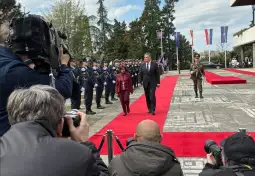
President Gordana Siljanovska Davkova, who is paying an official visit to the Republic of Croatia, was welcomed with the highest state and military honors by Croatian President Zoran Milanović in Zagreb on Tuesday. The presidents held a tête-à-tête meeting ahead of the conference, followed by a plenary meeting of the Macedonian and Croatian delegation.
The Macedonian President is also scheduled to meet with Croatia’s Prime Minister Andrej Plenković.
As part of her visit, President Siljanovska Davkova will lay wreaths at the Monument to the Homeland, and at the memorial bust of Blazhe Koneski in the Bundek city park.
She will also attend the opening of the exhibition “Archival Documents” by Macedonian artist Zhaneta Vangeli at the Macedonian Cultural and Information Center.
On Monday, Siljanovska Davkova visited the Macedonian Orthodox Church “St. Zlata of Meglen” and met with representatives of the Macedonian community in the country.
Photo: MIA


