Rubio says US, Europe are 'intertwined' but partnership must adapt
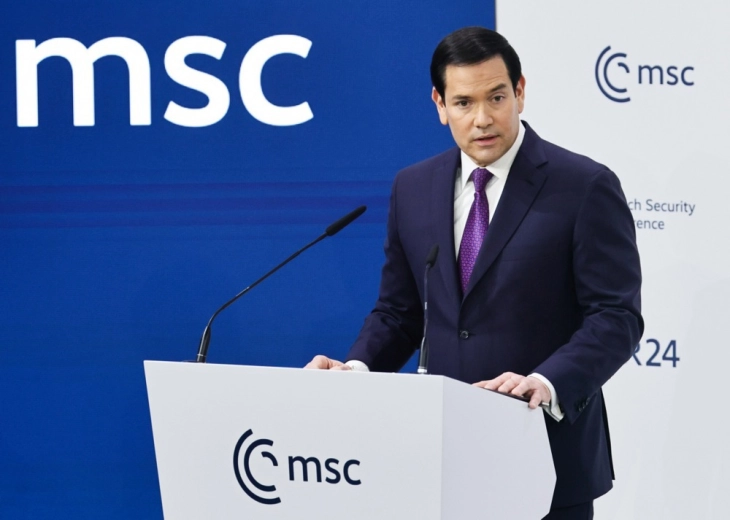
Munich, 14 February 2026 (dpa/MIA) - US Secretary of State Marco Rubio said the fates of the United States and Europe are "intertwined" in a speech at the Munich Security Conference on Saturday, while warning that the partnership must be recalibrated.
"We care deeply about your future, and ours," Rubio said in his 20-minute appearance, which was closely watched in Europe for signals of Washington's shifting foreign policy outlook under President Donald Trump.
"And if at times we disagree, our disagreements come from our profound sense of concern about a Europe with which we are connected - not just economically, not just militarily," Rubio added. "We are connected spiritually and we are connected culturally."
Pivoting away from the confrontational style employed by Vice President JD Vance during his infamous 2025 speech at the conference, Rubio used a deeply personal and historical framing, saying the US "will always be a child of Europe."
The message, while at times critical of Europe and global institutions, was resolutely pro-Western and was received with relief, with the audience interrupting Rubio to offer their applause.
“We want Europe to be strong," he told an audience of world leaders, ministers, senior military officers and policymakers. "We believe that Europe must survive, because the two great wars of the last century served for us as history’s constant reminder that ultimately our destiny is and will always be intertwined with yours."
While describing Europe as Washington’s closest and longest-standing ally, Rubio said the relationship must adapt to an increasingly competitive and dangerous global environment.
"For we in America have no interest in being polite and orderly caretakers of the West’s managed decline. We do not seek to separate, but to revitalize an old friendship and renew the greatest civilization in human history,” he said.
Rubio also sought to recast the modern relationship between the United States and Europe — forged after World War II through a web of political, military and economic partnerships — as an alliance rooted in shared heritage.
He denounced European governments over their migration policies, warning that the West was being "destabilized" by large-scale migration.
“Mass migration is not, and never was, some fringe concern of little consequence. It was, and continues to be, a crisis transforming and destabilizing societies across the West,” he said.
Rubio added that the United States and Europe must be “unapologetic in our heritage,” describing Western culture and history as “unique, distinctive and irreplaceable.”
Revitalizing trans-Atlantic ties based on shared heritage, he argued, would “rebuke and deter the forces of civilizational erasure that today menace both America and Europe alike.”
Rubio also used the speech to criticize the United Nations, saying it has “no answers” to the world’s biggest conflicts.
He said Washington did not want to destroy the international order it had helped to build, but that multilateral bodies must adapt and prove their effectiveness.
"We do not need to abandon the system of international cooperation we authored, and we don’t need to dismantle the global institutions of the old order that together we built. But these must be reformed, these must be rebuilt," he said.
He then set his sights on the UN, saying it still has “tremendous potential to be a tool for good in the world,” but had played “virtually no role” on the most pressing issues.
Instead, Rubio credited President Donald Trump’s leadership with helping to resolve flashpoints from Gaza to Ukraine to Venezuela.
US Vice President Vance stunned last year's audience with his blistering critique of European leaders, in which he accused them of suppressing free speech and dismissing the opinions of voters on the right.
The diatribe became a flashpoint in trans-Atlantic relations, accelerating calls for Europe to become less reliant on Washington for its security.
In the months that followed, Trump slapped steep tariffs on Europe, pursued a warmer relationship with Russian President Vladimir Putin and mounted an aggressive push to take over Greenland, plunging trans-Atlantic ties to a new low.


