Process defined by treaties, says EU Ambassador quizzed about accession with limited rights
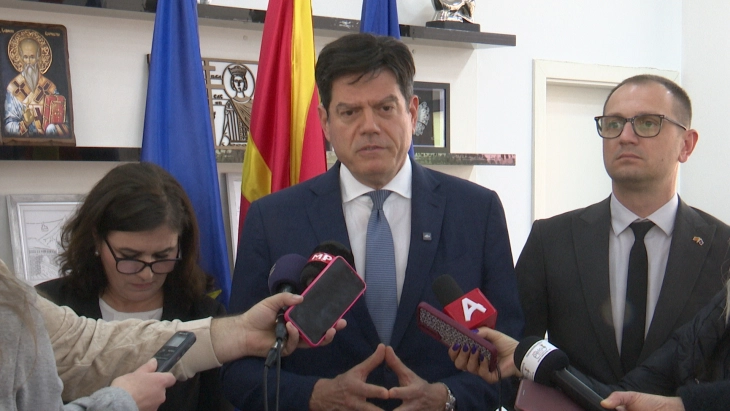
Prilep, 25 February 2026 (MIA) - The EU accession process is defined in the treaties of the European Union. There is nothing in those treaties that foresees any successful country that meets the membership criteria to not have, for example, the right to a vote or the right to a veto. Any changes would require approval from all members of the European Union, EU Ambassador Michalis Rokas told journalists Wednesday in Prilep.
“At the moment there is an ongoing political debate in the EU and in the region about how the European Union would actually handle the situation if there were four, five, or six successful candidate countries, and what their accession would mean for the Union. At the same time, the EU is trying to provide urgent responses to existing global challenges. So, there is debate across all areas within the Union. However, for now, the EU treaties remain as they are. Right now, the top priority for your country is to continue implementing reforms, which is the clear path forward for the Republic of North Macedonia,” said Rokas asked about the possibility raised by Prime Minister Hristijan Mickoski that the Western Balkans and Ukraine could join the EU in some form of arrangement, but without voting rights.
“The European Union never comments on such cases, which are directly related to the implementation of legislation itself. But our position has always been that everyone must be equal before the law. The rule of law must be applied equally, without any politicization or interference in its enforcement, whether in individual cases or across the board. As for the rule of law and the fight against corruption, we can already see that many activities are currently underway. We have information that the Ministry of Justice is working on drafting around 30 laws, and of course, we hope that the key issues related to the Criminal Code will soon be implemented, in order to strengthen the fight against corruption. We are awaiting a comprehensive and solid Criminal Code, and I am encouraged by the accelerated work being done to prepare these laws. We will see how this process unfolds and, of course, we will monitor the implementation of the legislation,” Rokas told journalists in Prilep.
Photo: MIA


