OSCE research: Two-thirds of young women and girls victims or witnesses of gender-based violence
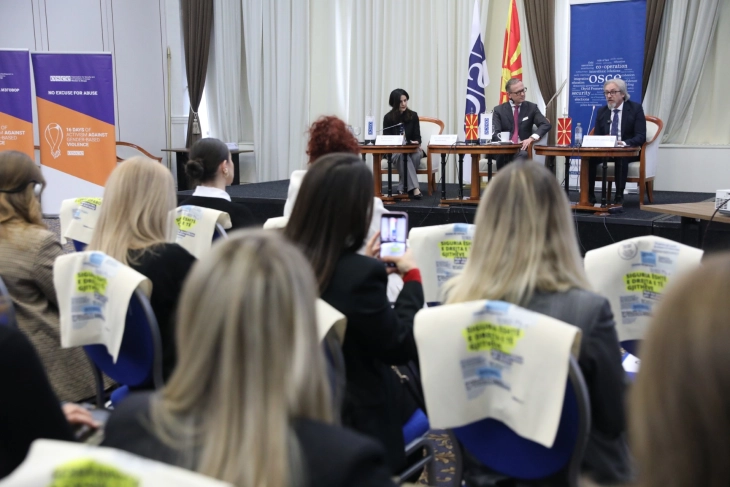
Skopje, 17 December 2025 (MIA) - The OSCE Mission to Skopje presented Wednesday new research on online and offline violence against young women and girls in public life. The research highlights that a significant proportion of young women feel unsafe in public spaces due to their gender, with vulnerabilities shaped by socio-economic factors, education, and place of residence. It also points to low reporting rates and the need for improved co-ordination, accessibility, and trust in institutional responses.
“The findings of the research show that young women and girls are aware of where to turn in cases of gender-based violence, however, they still feel unsafe in digital space and large public spaces. Two-thirds of all respondents reported having been either victims or witnesses of gender-based violence in various forms. The most common types are economic, verbal, psychological and physical violence. What is particularly concerning is that 34 percent have been either victims or witnesses of violence. Different forms of violence dominate in different public spaces,” said Zhaneta Poposka, National Rule of Law Officer at the OSCE Mission in Skopje.
According to Poposka, verbal abuse and psychological harassment are most common in educational institutions, while sexual harassment predominates in public spaces. “What is particularly alarming is that only five percent of women who have been victims or witnesses of gender-based violence reported it. The main reason for not reporting include fear, stigma, lack of trust in institutions to respond promptly and fear of repeated violence,” Poposka stated.
Regarding the digital space and its effects on young women and girls, the findings show that 10 percent have experienced it as victims, while another 15 percent have witnessed it.
“This means that one in four young women or girls have been affected by this type of violence. What is particularly alarming is that even fewer report it. Most commonly, they turn to family and friends for emotional and psychological support, and far fewer seek help from institutions,” Poposka said.
On a positive note, she highlighted that the police are seen as the primary institution to respond in cases of gender-based violence.
Opening the event, Ambassador Kilian Wahl, Head of the OSCE Mission to Skopje, stressed the importance of turning research into sustained impact.
“When violence happens, silence is not an option. We all have a responsibility to react and to report. Reports of violence must be treated as a priority, and institutions are obliged to act with due diligence,” Wahl said.

Minister of Social Policy, Demography and Youth Fatmir Limani emphasized the importance of co-ordinated social support.
“We must build a system that responds early, in a humane and co-ordinated way, so no woman is left alone. We are preparing a new Strategy for Addressing Violence against Women and Domestic Violence for 2026–2033, together with an Action Plan for 2025–2029. These strategic documents will guide timely and effective protection for every woman,” Limani said.
Conducted in 2025 by the research firm Indago, the study is based on a representative sample of 600 young women and girls aged 18 to 29 from all planning regions of the country, complemented by focus groups with civil society and experts. It provides detailed insights into perceptions of safety, reporting patterns, institutional responses, and emerging risks, including digital violence.
Through the Youth Violence Prevention Task Force, the OSCE Mission to Skopje will continue to work with national stakeholders to integrate the validated recommendations into policy development and practical measures, ensuring long-term sustainability and measurable impact.
Photo: MIA


