Large Macedonian diaspora in Australia the strongest link between the countries, no change of visa regime, Ambassador Truswell tells MIA
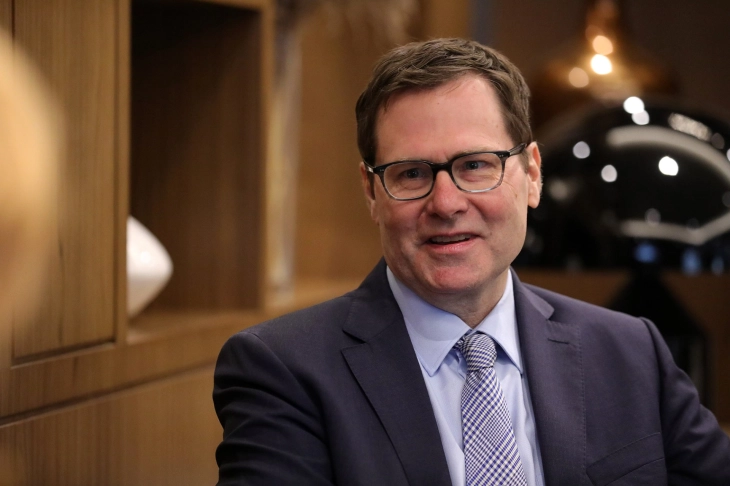
Skopje, 28 November 2025 (MIA) – Our bilateral ties are in very good shape. There is a strong link between our countries, we share common values. There is a strong link between our nations, namely the large Macedonian diaspora. Australia is one of the biggest destinations for Macedonians that migrated in the last 50 or 60 years. I hope for stronger ties in the future in terms of political and parliamentary cooperation as well as in the economy, Australian Ambassador to North Macedonia, based in Belgrade, Peter Truswell, says in an interview with MIA.
Regarding economic cooperation, he says it will be one of the priorities of his term, which started in May. He also says there are potential areas for Australian companies to invest in.
“There are already some strong resources, companies operating here, and I have had good constructive meetings with the Macedonian government about the prospects to do more in the resources space. So that's number one. Number two, I think you are increasingly a center for IT and there are a couple of Australian companies that are active in this space. But I would like to see more, so I'm talking to companies, talking to chambers of commerce to see if we can have more in the IT space because the level of qualifications here is high. The language skills, English language skills are high. And this is a different time zone. So, there are lots of potential there,” Truswell says.
On the possibility of Australia lifting visas for the Macedonian citizens or even facilitating the procedure, the Ambassador says there are no proposals for major change.
“Australia is a continent, so it's possible for us to control the movement of people and migration more easily than, for example, in Europe. The visa regime that we have is not discriminating against any particular country. It's designed to help with that. But look, we're always ready to entertain or listen to requests for changes and to consider them. But so far as I'm aware, there's no proposals for major change that are being looked at in any detail at this time, that I know of,” states Truswell.
The Australian embassy has organized several events to mark the 30th anniversary of the diplomatic ties, including a reception, an exhibition of Indigenous textile art from Australia's Bábbarra Women's Centre at the Museum of Contemporary Arts, and a film festival at the Cinematheque in Skopje on Friday and Saturday, during which two films will be shown – “Housekeeping for Beginners” by Australian-Macedonian film director Goran Stolevski, and “Backyard Ashes”.
Australia has a Macedonian diaspora of 115,000 people, but it is believe the number is much higher.
North Macedonia and Australia established diplomatic relations on December 20, 1995.
Australia Ambassador Peter Truswell’s interview with MIA is below:
2025 marks three decades since the establishing of diplomatic ties between Skopje and Canberra. How do you assess the bilateral relations between North Macedonia and Australia?
I think that they are in good shape, very good. We organized a reception to celebrate 30 years of the diplomatic relations between our two countries. Unfortunately, the Australian Foreign Minister, Penny Wong, wasn’t able to come for this event, but she has recorded a message.
And Timcho Mucunski has recorded a message because he is overseas as well. And these messages were broadcast at the reception.
In the message, the foreign minister of Australia makes clear that there's a strong link between our two countries. We share common values. We have strong links between our two peoples, and the relationship is in a good place. So basically, the things to mention are first, a lot of people from North Macedonia migrated to Australia, some came back, some stayed. Many have now had families, maybe it's the second or third generation. So, there's a strong link, and Australia is one of the biggest destinations for Macedonians that migrated in the last 50 or 60 years. Most people that I meet here have some connection to Australia, people-to-people. That creates good business links. People come here, small businesses, family businesses. People buy hotels, for example in Ohrid, get involved in wine-making, which is good.
The biggest things in the relationship, economically, are in the mining and resources sector. There are a few Australian companies who are doing some good exploration, and they have some good prospects for opening mines. Of course, they have to be consistent with all the environmental standards and meet the government's requirements. That's an area that Australia has a lot of expertise in. We have a lot of mines. We're also the biggest exporter globally, for example, of iron ore, and the second-biggest exporter of gas. So, we have a lot of experience.
Minister of Foreign Affairs and Foreign Trade Timcho Mucunski visited Australia in the beginning of the year to mark 30 years of diplomatic relations between the two countries. It was the first high-level visit in 15 years. Can we expect the political dialogue between the countries to become more dynamic?
I was lucky enough to meet Minister Mucunski when he came to Australia in Canberra before I started my job here. I was also with him when he went to the Australian Parliament House to what we call question time when the two sides. And I went with him when he met with the Australian Foreign Minister, and also went with him when he saw the Australian War Memorial in Canberra, which commemorates people who died in all the different wars from Australia and from other countries actually. And I do know from speaking to the minister afterwards that he's keen to maintain that level of a relationship between the two countries. I think and we would like to see if it's possible for senior officials from Australia to come here. I look forward to stronger ties in the future at that level of officials, at least, and ministers.
Regarding parliamentary cooperation, the Group of Friendship was re-established in the Australian parliament for cooperation with members of the Macedonian assembly. Is this a good sign for the relations between the two countries?
Australian MP Cassandra Fernando visited North Macedonia twice in the past couple of years to meet with lawmakers. I met recently the speaker of your parliament, and we talked about parliamentary cooperation. I think it's so important because we both have these strong traditions of democracy, and there's a strong link between the people in the two countries.
It creates a broader dimension to the bilateral relationship to have that strong parliamentary interaction. When Minister Mucunski was in Canberra, he met with the Parliamentary Friendship Group. I went along with him. Very constructive meeting. Think there's a lot of potential.
The governments have signed several agreements in the sphere of social policy and also between the police forces and there is also an agreement on the fight against transnational crime and terrorism. Is there a plan for other agreements to be concluded?
There's always scope for two friendly countries like ours to do more together and to reach new agreements.
Your term began in May when you handed over your credentials to President Gordana Siljanovska-Davkova. In the meeting, you said your mission is to strengthen the countries’ economic relations. What initiatives are you planning in that regard?
There are already some strong resources, companies operating here, and I have had good constructive meetings with the Macedonian government about the prospects to do more in the resources space. So that's number one. Number two, I think you are increasingly a center for IT and there are a couple of Australian companies that are active in this space. But I would like to see more, so I'm talking to companies, talking to chambers of commerce to see if we can have more in the IT space because the level of qualifications here is high. The language skills, English language skills are high. And this is a different time zone. So, there are lots of potential there.
For example, in clean energy, which is something that I know the government here has a very good strategy. It's working with other partners such as the UK. And I think we can, based on the strong expertise and knowledge that we have in Australia, help. For example, Australia has the highest number of solar panels on the roofs of houses in the world. We have a very ambitious target to move to renewables. There's a lot of things we can talk about in that space.
Is there tendency to increase trade?
I would like to see the trade rise significantly. We need to build better trade. The way that we cooperate and have close connections with the different ministries here, I think we can see some potential there, and hopefully we can produce change. And I know that if you look at the statements that Minister Mucunski made when he was in Australia, he said the same thing. Both governments are trying to make a difference in that space.
As regards cultural cooperation for example, or in the sphere of education. Is there a chance to lift visas for Macedonian citizens who want to visit Australia or at least to ease the procedure?
Australia is a continent, so it's possible for us to control the movement of people and migration more easily than, for example, in Europe. The visa regime that we have is not discriminating against any particular country. It's designed to help with that. But look, we're always ready to entertain or listen to requests for changes and to consider them. But so far as I'm aware, there's no proposals for major change that are being looked at in any detail at this time, that I know of.
North Macedonia has an embassy in Canberra and a consulate general in Melbourne, which is in the service, amongst other things, to the large Macedonian diaspora in Australia. Is there a chance for Australia to open a resident embassy in Skopje?
A good question and that's a question that I get asked very frequently. That would always be a decision for the Australian government, a political decision. But for the time being, we have an excellent honorary consul here who's been doing a fantastic job from the embassy in Belgrade. We come very frequently and we're doing all we can to make a difference in the bilateral relationship.
Regarding geopolitics. What’s your opinion on the ongoing negotiations about Trump’s peace plan for Ukraine, which has been gripped in a delicate phase?
Let me just repeat what our foreign minister said in the last couple of days. So, she said about the proposals for a peace deal from the American side and from others, of course, that we, Australia, support efforts to achieve a peace deal that ends Russia's illegal and immoral war, and safeguards security and stability in Europe. She also said, "A lasting peace should uphold Ukraine's sovereignty and territorial integrity, support security and stability in Europe, and," importantly, very important, "ensure Russia does not renew," start again, "its aggression."
What about Australia’s cooperation with NATO with North Macedonia being part of it.
We are in a region that we call Indo-Pacific. So, it goes from, let's say, India to United States and all the countries in the middle there, Southeast Asia, North Asia. That's our region, right? Our region is not Europe. This is the Euro Atlantic region. But because of the illegal immoral war in Ukraine, there's more scope or more need for cooperation between the two different regions. For a start, Australia is the biggest contributor to Ukraine's defense outside of NATO.
We have contributed $1.5 billion of assistance to Ukraine, and that's Australian dollars, not US dollars. That's the biggest outside of NATO. You've seen soldiers from North Korea, from DPRK, fighting in Russia. That tells you that this is not just a problem for this region. It's a problem that crosses different regions and is important also to us. Australia is part of a small group of countries that includes also Japan and others, that has very regular, very close cooperation with NATO in the headquarters in Brussels and elsewhere. We have close dialogue with NATO. Our ministers go to the important NATO conferences.
The important thing also to say is that we really welcome the fact that your country has now, for quite a few years, been in NATO. That's really important for the region. We really commend the assistance that you have given to Ukraine. Quite a lot of assistance for a small country, and that's very welcome. There for sure is scope for us to do more between Australia, which is part of this alliance relationship, as I said, between US, Australia and New Zealand, which has existed for many, many years, and NATO. But we're not a part of NATO, but we support what NATO does.
Do you have any comment on the Macedonian path to EU membership?
As a matter of principle, across the Balkans, we would like to see enlargement of the EU. It's important for the prosperity of the countries in the Balkans. It's important for the stability of the region. We would love to see North Macedonia move forward with its negotiations with the EU. But of course, we're not part of the EU, so we can't really comment on it beyond saying that we hope that the differences of opinion can be resolved, and that you can move forward with your negotiations.
What activities will take place to mark the 30th anniversary of the establishment of diplomatic relations between the two countries?
It's a big deal, this 30th anniversary. It's a big deal also for the many Macedonian Australians. We want to show that for the Australian government and the Australian people, it's important as well. We have a few different events happening during about a week to celebrate that. We have a big reception. We'll have some Australian music. As I said, we had the messages from the foreign ministers. It was a big, important event and it was a chance for many people here in Skopje to celebrate that. On Tuesday, we opened an exhibition of First Nations Indigenous art. I would encourage people to go and visit that in the Museum of Contemporary Arts. We have a small film festival, a couple of films that we're showing at the Cinematheque on Friday and Saturday.
A world-famous mural artist will paint a mural that will symbolize the partnership between our people in Bitola. He's working on it now. Let's hope he's finished by Saturday, and then we can let people see the finished product. I think, the idea there was to have something lasting, something that people can look at. At the 40th anniversary, for example, that mural will still be there.
Photo: Frosina Naskovikj


