‘Abecedar – A Hundred Years Later’ republished with scholarly texts by professors Jurukova, Achkoska and Jacheva-Ulchar
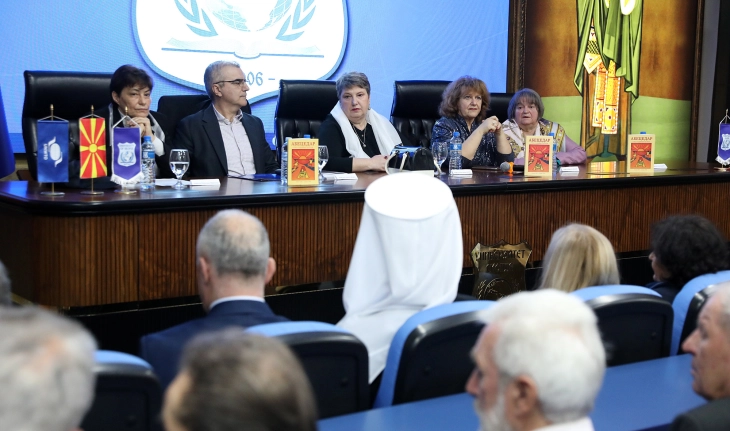
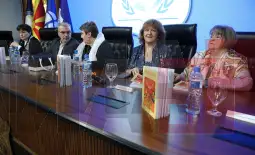
Skopje, 13 December 2025 (MIA) - The Macedonian primer “Abecedar – A Hundred Years Later” (1925–2025), containing texts by Prof. Dr. Nada Jurukova, Prof. Dr. Violeta Achkoska, and Prof. Dr. Elka Jacheva Ulchar, was promoted Saturday at the University of Skopje.
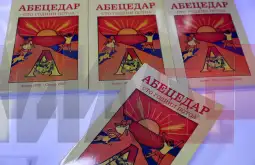
The jubilee edition “Abecedar – A Hundred Years Later” is divided into two parts. The first part features a foreword and three scholarly texts by Prof. Dr. Nada Jurukova, Prof. Dr. Violeta Achkoska, and Prof. Dr. Elka Jacheva Ulchar, while the second part presents the original “Abecedar” on the left side of the book, with the Cyrillic-transcribed pages on the right.
At the promotion, Todor Petrov, President of the World Macedonian Congress, emphasized that the “Abecedar” was first printed in Athens in 1925 as a testament to the existence of Macedonians in Greece and around the world.
The promoter, Prof. Dr. Nikola Zhezhov, stated that Macedonian historiography has produced several reissues of the “Abecedar,” and the latest edition is here before us as a primary historical source for the recognition by the Athens government of the Macedonian nationality within its state territory.

“Today, in this new historical reality, we as Macedonians have an indisputable and valuable historical document from a century ago, which serves as direct evidence that in 1925 Greece planned Macedonian-language education for the needs of Macedonian children within the Greek educational system. Even greater significance of the “Abecedar” is given by the fact that its authors were Greek by nationality and that the textbook was prepared at the request of the Greek Ministry of Education. These last two indisputable facts should be our key arguments before the world public when we speak and debate the Macedonian issue, the rights of Macedonians in the Aegean part of Macedonia, and Greece’s unfulfilled obligations and its withdrawal from recognizing the existence of Macedonians on its territory,” Zhezhov emphasized.
According to him, the “Abecedar,” republished and supplemented with scholarly texts by Professors Jurukova, Achkoska, and Jacheva Ulchar, should be shown to every foreign scholar, historian, philologist, or anyone interested in Macedonia and its history, as it serves, he said, as a direct response to Greece’s denialist policy regarding the national character of the Macedonian issue.
Prof. Dr. Violeta Achkoska stated before the promotion that the “Abecedar” is unique because of the alphabet in which it was written.
“The Abecedar was written in Latin alphabet, this was probably a Greek maneuver to avoid using Bulgarian or Serbian Cyrillic, since the Bulgarians and Serbs had sought protection for their minorities in Greece. The Greeks claimed that it was neither a Bulgarian nor a Serbian minority issue, but rather concerned an autochthonous Slavic-speaking population, as they called it, because they avoided using the term ‘Macedonian.’ This is a Slavic-speaking population in Greece that is autochthonous, neither Bulgarian nor Serbian, speaking its own authentic language. The primer actually expresses the language of this autochthonous area, but the alphabet is Latin due to the political context present at that time in the historical climate,” Achkoska said.
She explained that this primer was not used in the educational process; some people saw it, but it was soon destroyed by the Greek state.
“However, as long as a copy was preserved, it effectively meant that it had been seen. In 1985, it was republished in Greece for the first time. It existed there, the Macedonian population knew about it, but unfortunately, just as no Macedonian minority was officially recognized and Macedonians had no educational, political, or national rights, this primer also remained unused. It was never put into practice. During World War II and the Civil War, in the territories where the Communist Party operated, some Macedonian schools were opened, but at that time a new primer was created, not the Abecedar. The Abecedar was republished for the first time 60 years after its initial publication. In Macedonia, it has been reissued several times, and now we have created a more complete edition, different from the others, with a transcription from Latin to Cyrillic by my colleague Jacheva Ulchar, a wide historical overview by my colleague Nada Jurukova, and I contributed the section on current relevance, examining the meaning from today’s perspective and how history repeats itself from the pre-war period to the present day,” Achkoska noted.
At the promotion, Aleksandar Janevski, President of the Union of Associations of Macedonians and Refugee Children from the Aegean Part of Macedonia “Macedon,” reported that on 16 December 2023, the “Macedon” Union, during the academy at MANU commemorating ninety-eight years since the publication of the “Abecedar” in Athens, accepted the initiative of Professors Nada Jurukova, Violeta Achkoska, and Elka Jacheva Ulchar to republish it in 2025 on the occasion of its 100th anniversary.
“That is why we are gathered here today. Our sincere and heartfelt gratitude goes to them for their initiative and authorship in its jubilee republication. This year we also mark 76 years since the end of the so-called Civil War in Greece (1946–1949) and 77 years since the exodus of Macedonian children from the Aegean part of Macedonia in 1948. We remember the darkest page in the modern history of the Macedonian people. We remain committed to a lasting solution to the Macedonian question, based on the already established universal, inalienable, irrevocable, and inviolable right of self-determination and self-identification of the Macedonian people in the sovereign and independent state of Macedonia, in accordance with the decisions of the referendums held on 8 September 1991 and 30 September 2018,” Janevski said.
We demand, as he stated, the urgent and unconditional unilateral termination of the Zaev-Borisov Agreement of 1 August 2017 and the Osmani-Genchovska Protocol of 17 July 2022, as well as the Dimitrov-Kotzias Agreement of 17 June 2018, because they represent the sanctioning of the Bucharest Treaty of 10 August 1913, with the aim of turning Macedonia from a state into a territory without a Macedonian people or history, whose administrators would be Athens and Sofia.
“We demand the urgent and unconditional continuation of our membership in the United Nations under the one and only state, historical, and generic name consisting of a single word-the word Macedonia! We also demand the immediate and unconditional unilateral dissolution of the intergovernmental Macedonian-Bulgarian and Macedonian-Greek commissions for the revision of Macedonian history,” Janevski said.

The promotion was attended by Head of the Macedonian Orthodox Church, Archbishop of Ohrid and Macedonia, HH Stefan, university professors and writers.
Photo: MIA


