Religious leaders condemn synagogue arson attempt in Skopje
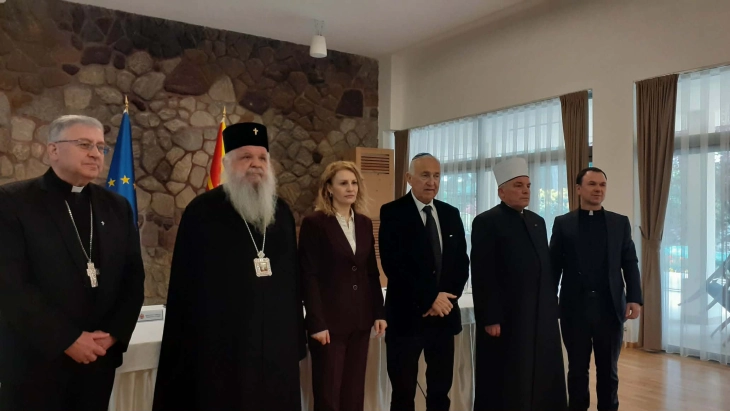
Skopje, 15 April 2026 (MIA) — An attempted arson attack on the Jewish Community building and the Bet Yaakov synagogue was a direct strike against the centuries-old peace and coexistence of Macedonian society, the nation's top five religious leaders said in joint statement issued together with the Commission for Relations with Religious Communities and Religious Groups.
At a press conference held earlier Wednesday, Commission for Relations with Religious Communities and Groups director Olivera Trajkovska read the statement and stressed that any attack on a sacred site, regardless of the faith it serves, violates the core values of respect, freedom and human dignity. She noted that disrespecting another person's place of worship was ultimately a sign of disrespect for one's own.
The group gathered to officially condemn the April 12 early-morning attack while offering solidarity and support to the Jewish community.
Trajkovska urged citizens to act with responsibility and reason to protect the country's tradition of mutual understanding and respect. "Mutual respect is one of the greatest values we possess," she said, highlighting the need to pass it down to the next generation.
The conference included the leaders of the Macedonian Orthodox Church, the Catholic Church, the Islamic Religious Community, the Jewish Community and the Evangelical Methodist Church.
Pepo Levi, president of the Jewish Community, noted that the joint response reflects the long-standing cooperation and constructive dialogue between the country’s various faiths.
When asked for updates on the investigation, Levi said the community was not pushing for details that might compromise the police investigation. He said that although finding the perpetrators was important, it was not the most critical issue.
"The essential thing is the lesson we learn from this," Levi said. He pointed out that Macedonia had not seen such an incident against the Jews since the Holocaust in 1943, when 7,144 Macedonian Jews were deported to the Treblinka death camp.
"I hope that we will not allow external conflicts and influences to spill over into our Macedonia, where we live in peace, coexistence and have understanding and close relations between all religious communities," Levi said.
"We do not know whether they are terrorists or hooligans, but the fact is that the Islamic State, ISIS, had a proclamation for Easter to set Christian and Jewish religious objects on fire. Whether this was due to that call or something else, the police will determine," he said.
Despite global tensions, including the conflict in Gaza, Levi said Macedonian religious groups have remained united.
"A small country like Macedonia must preserve its peace, tranquility and coexistence," Levi added, expressing confidence that the authorities would root out any emerging religious intolerance among young people.
Shaqir Fetahu, head of the Islamic Religious Community, told reporters that there was no friction between Muslim believers and other religious groups in the country.
Fetahu said young people showed great respect for all faiths, which was evident in how people live together daily without conflict.
He said all religious communities advocated for the highest level of coexistence and tolerance.
"I believe that such elements do not originate from any religion in Macedonia. As to who and what they are, the responsible authorities should find the perpetrators," he said. mr/


