Janevska: Strong higher education is vital to addressing key challenges of modern societies
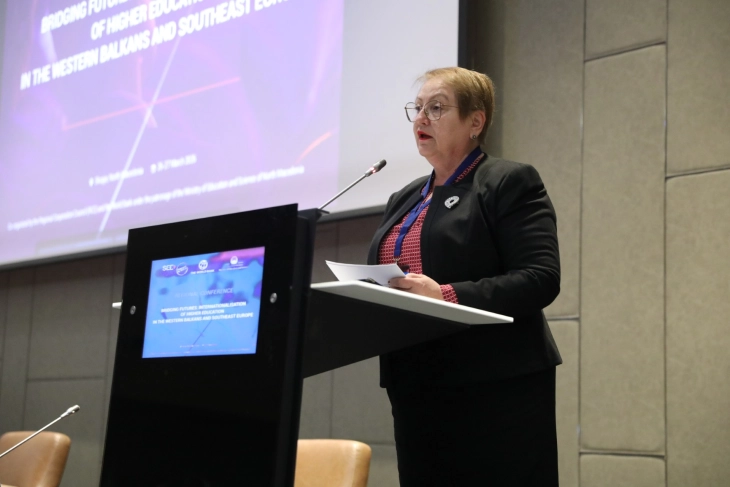
Skopje, 26 March 2026 (MIA) – Higher education must ensure that our societies develop and are governed on the basis of factual knowledge as well as reasoning and creative thinking. Such universities are the goal for all of us in the region, Minister of Education and Science Vesna Janevska said at the opening of the two-day regional conference “Bridging Futures: Internationalisation of Higher Education in the Western Balkans and Southeast Europe” in Skopje, organized by the Ministry of Education and Science in partnership with the Regional Cooperation Council and the World Bank.
She pointed out that the major geopolitical changes taking place are strengthening the awareness in small countries like ours that education is our most secure investment, and that the future of our economies, their sustainability and resilience depends on our determination and ability to deliver quality higher education.
“Without a strong contribution from the higher education community through research, learning and teaching, societal impact, innovation, and technology transfer, the key challenges of modern societies cannot be addressed, including those related to the United Nations Sustainable Development Goals, the survival of our planet, issues of war and peace, democracy, and coexistence. Under the University Charter 2020, universities are expected to engage with and address pressing issues, contributing to the well-being of humanity and sustainability. Higher education should enable societies to grow and be guided by facts, reason, and creative thinking. These are the types of universities we all aspire to in the region,” Janevska said, highlighting that internationalisation is crucial, as exchanges foster innovation through joint projects and partnerships, while opening access to knowledge, technology, and funding.
As she said, internationalization is an indispensable mechanism that enables students to acquire stronger digital and green skills, while helping countries move toward innovations that create new jobs and making the region more competitive in the European and global market.
“In the period ahead, we face intensive work aimed at deepening mutual cooperation and building institutional capacities, as well as ensuring equal access for all students and teachers to shared educational goods. However, the challenges are numerous. Universities and states have limited resources for mobility programmes, research projects, and infrastructure. The lack of stable funding makes internationalization dependent on donations rather than on a long-term strategy. In this regard, as a country, the Republic of Macedonia has made a major step forward over the past year and a half. We have increased investments in higher education and science, and we are firmly committed to ensuring that budget allocations for this purpose continue to grow in the coming years,” Janevska said.
The growth of cooperation, she said, also depends on bureaucratic procedures, institutional capacity, and alignment with European standards, while the biggest barrier, as she noted, remains the fear that mobility will further deplete an already weakened academic and research community, with the most talented students, most productive professors, and most dedicated researchers leaving and not returning.
“We need to demonstrate our ability to turn brain drain into brain circulation. The aim is not to stop mobility, but to shape it into a process where students and professors go abroad and return with new knowledge, networks, and ideas. In this way, internationalization becomes an approach that enriches rather than depletes our academic community, making it more competitive while also driving innovation and national development. And equally important, from the perspective of participants in academic exchange, it must remain accessible to all, not just to those with financial means. We must not allow students and teachers to be evaluated outside academic criteria and thus excluded. Financial considerations must not be decisive, nor should universities see internationalization solely as a means to attract foreign students for revenue. It is, and will remain, a tool for improving higher education and facilitating knowledge exchange,” Janevska noted.
Janevska concluded her address with the message that international cooperation in higher education must remain inclusive and quality-focused.
As she said, she expects the discussions at the two-day conference “to help position the Western Balkans within broader European and global higher education networks” and expressed confidence that “we will arrive at actionable steps to guide our reforms toward modernizing teaching, advancing research, and creating inclusive conditions for students and faculty, with the aim of building a competitive and recognizable regional academic space.”
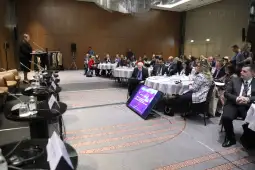
The conference, held Thursday under the patronage of the Ministry of Education and Science, represents a high-level dialogue bringing together ministers, university leaders, academics, researchers, policymakers, industry representatives, employers, experts and students.
Bridging Futures is more than a conference-it is a platform to connect systems, people, and ideas and to shape the next phase of higher education reform in the Western Balkans.
Participants will discuss the competitiveness of universities and their alignment with European and global standards, innovation and digital skills, particularly in STEM fields, mobility policies and creating conditions for young people to study, research, and work in different countries while ensuring that acquired knowledge is brought back to the region, as well as strengthening cooperation aimed at sharing best practices and experiences.
“Despite historical and institutional differences, the six Western Balkan countries share common challenges, values, and aspirations. Through dialogue and the exchange of ideas, the region seeks to demonstrate that it is not merely a passive participant in European processes, but an equal partner that can enrich Europe with knowledge, talent, and innovation,” the Ministry of Education and Science stated in the conference announcement.
Photo: Ministry of Education and Science


